Every ClientBranch Feature, Explained: The Full Tour
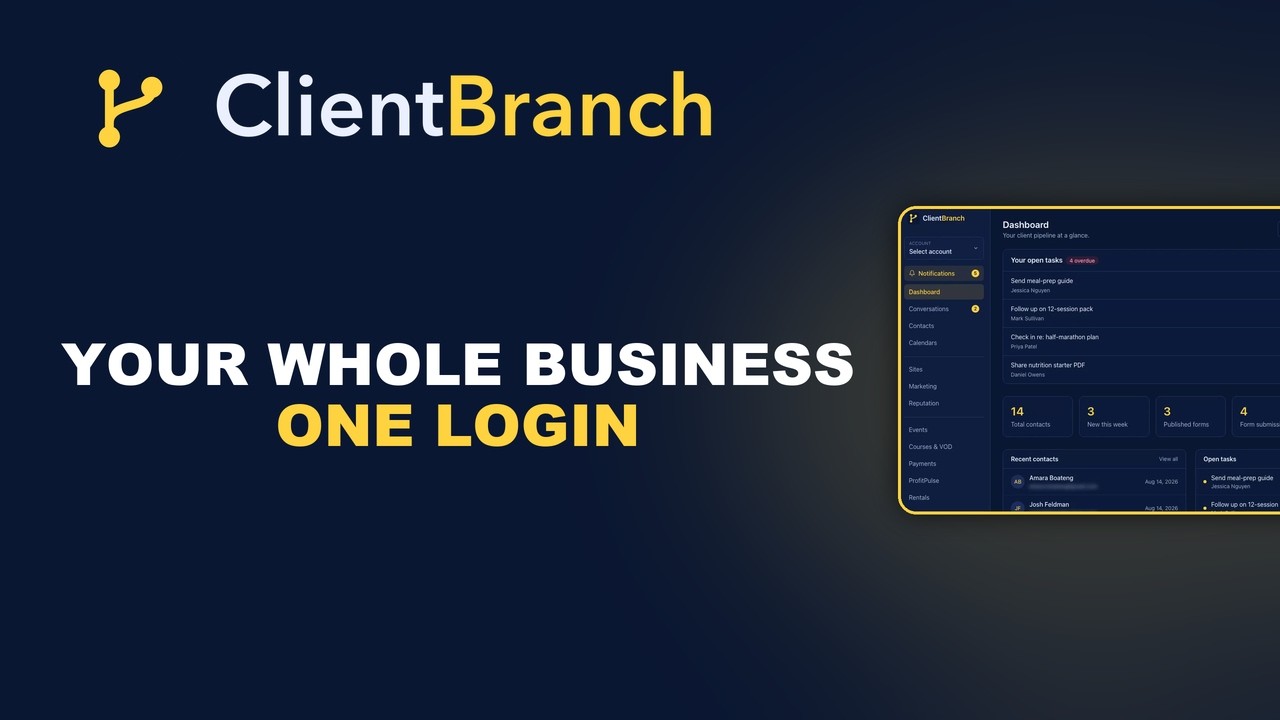
One login for your inbox, CRM, bookings, sites, marketing, store, events, courses, contracts and payments. A walkthrough of every feature on the platform, with the two minute video tour.
Ask ten business owners what software they pay for and you will get the same tired list: a booking tool, an email platform, an invoicing app, a website builder, a forms tool, something for texting, something for reviews, and a spreadsheet quietly holding the whole thing together. Each one has its own login, its own bill, and its own opinion about how your day should work.
ClientBranch exists because none of those tools talk to each other, and you are the one paying for the silence. This post walks through every feature on the platform and, more importantly, what each one changes about your week. The two minute tour above covers the same ground at speed; this is the version with room to breathe. Watch first, read second, or the other way around. We will wait either way.
The daily loop: inbox, contacts, calendar
Conversations: one inbox, every channel
Email and two-way text live in the same thread, organized by contact rather than by app. The question a client texted on Tuesday sits directly above the email they sent on Friday, so you answer with the full story in front of you instead of reconstructing it from memory. The benefit is speed where speed pays: studies put lead conversion several times higher when you reply in the first few minutes, and one inbox with one unread badge is how you keep doing that at 4 PM on a Thursday. Your email signature, reply history and the contact's whole record are one click away, and nothing ever falls between two apps again.
Contacts: a CRM that fills itself
Most CRMs die because somebody has to feed them. This one feeds itself: every form fill, quiz answer, chat message, booking, ticket purchase and store order creates or updates a contact automatically, tagged with where it came from. Consent and do-not-disturb are tracked per channel, which is not paperwork, it is protection: marketing stays away from people who opted out while their booking reminders still arrive, so you stay compliant without thinking about it. Smart lists are saved filters that keep themselves current, meaning "hot leads who have not booked yet" is a list you build once and never maintain. Companies group your contacts by the business they belong to, and tasks keep the follow-up you promised from evaporating.
Calendars: bookings without the back-and-forth
Every "what time works for you?" email thread is money leaking out of your week. Clients pick from your real availability in their own timezone, and the calendar enforces your rules for you: buffers between sessions so you are never back-to-back, minimum notice so nobody books you for tonight, approval mode when you want the final say. Take a deposit or the full price at booking and no-shows fall off a cliff, because people show up for things they have paid for. Confirmations, reminders and reschedule emails send themselves. Booking links carry your business name instead of a code, teams can round-robin bookings to whoever is free, and two-way Google Calendar sync means a dentist appointment on your personal calendar blocks that slot everywhere.
Getting found: sites, capture, marketing, reputation
Sites: your presence, built in an afternoon
Describe your offer in a sentence or two and the AI writes a complete landing page around a proven conversion structure: outcome headline, the problem, social proof, the offer, objections answered, one repeated call to action. You edit words on a page instead of staring at a blank one, and publish on your own domain or ours. The website builder adds a full multi-page presence with shared navigation and footer, and the blog is built for the search era you are in, not the one that ended: structured data, clean meta, feeds, and the on-page signals that rank on Google and get you quoted by AI search engines. Draft everything in private, preview at a real URL only you can open, and publish when it is right. The benefit is blunt: the web presence that used to take an agency and a month takes you an afternoon, and every page feeds the same CRM.
Forms, quizzes, chat and QR: every visitor can raise a hand
Different people put their hand up in different ways, so you cover all of them. Forms match your site's styling, support signature fields for intakes and waivers, and filter spam with honeypot and timing checks so junk never becomes a contact. Quizzes are the quiet star: a "which package is right for you" quiz entertains the visitor while it scores their answers and tags them by result, which means your follow-up can speak to exactly what they need instead of guessing. The chat widget catches people with a quick question before they drift off. Trackable QR codes turn posters, flyers, table tents and stage screens into measurable lead sources, every scan counted. All of it lands in one submissions inbox, and every submission fires your automations.
Marketing: campaigns you send, sequences that send themselves
The visual composer gives you a branded email without touching HTML; save it as a template once and reuse it forever, so campaign number forty looks as sharp as campaign number one. Send to everyone, a tag or a smart list, and watch opens, clicks and deliveries live, so you learn what your audience opens instead of guessing. Automations are where the compounding happens: a welcome series that greets every new subscriber, a nurture drip that warms up leads, an instant reply to every form submission, each contact moving through on their own clock. Tag steps move people between lists mid-sequence, and exit tags stop a sequence the instant somebody converts, so nobody is chased for a thing they already bought. The social planner lets you write your Facebook and Instagram posts ahead of time, and once automatic posting switches on it will publish them, and your new blog articles from RSS, for you, which keeps your channels alive on the weeks you are too busy doing the work to talk about it.
Reputation: reviews on autopilot
You already know reviews decide who gets called. The hard part is asking, consistently, at the right moment, and that is exactly what this does: after a booking or sale, the request goes out on its own. Happy clients get routed straight to Google where their stars do the selling; unhappy ones are caught privately first, giving you the chance to fix things before they go public. That routing alone is worth the feature. Your best reviews build a testimonial wall you can embed on any page, always current without you curating it, and every glowing review turns your happiest clients into your cheapest marketing channel.
Getting paid: events, courses, store, payments
Events: sell out the room, keep every dollar
Free RSVPs or paid ticket tiers, early bird pricing on a schedule, per-event discount codes, and a public event page you share anywhere. Tickets carry a QR code you scan at the door from any phone, so check-in is a queue that moves. Attendee-only details reveal on the private ticket page, one-click updates email every ticket holder when the venue changes, and every registrant lands in your CRM tagged by event, which turns tonight's audience into next season's mailing list. The line that matters most: there are no per-ticket fees, ever. On a hundred $35 tickets, the platforms that "only" take a few percent are quietly taking a table's worth of revenue. Here that money stays yours.
Courses and video on demand: teach it once, sell it forever
Your knowledge is inventory that never runs out; it just needs shelves. Build full courses with lessons, enrolled students with their own logins, progress tracking and completion certificates that make finishing feel like something. Or skip the course structure and sell single videos to rent or own, organized into libraries, ideal for a recorded show, a masterclass or a workshop replay. Either way you earn from work you did once, and every buyer is a contact you can market the next thing to.
Store and selling in person: a checkout wherever the customer is
The online store sells products, services and packages from a hosted storefront with a cart and card checkout, dressed as your shop, not ours: your hero image, your header links, your footer, items organized into collections so browsing feels like a real store. Packages bundle several offerings into one sellable item that shows buyers everything included. And when the customer is standing in front of you, holding the merch, sell in person turns your phone into the card machine: tap what they are buying, show the QR code, they pay on their own phone with Apple Pay, Google Pay or a card. No reader in your pocket, no "I'll pay you later," no lost sale at the merch table. Every order, online or in person, lands in the same list with the buyer saved to your CRM.
Invoices, proposals, contracts, coupons and brands
Invoices and proposals share a live preview that looks like the finished document while you build it, with deposits, payment schedules, tips and optional processing-fee pass-through. Duplicate any invoice to reuse it as a template, so the paperwork for your standard job takes a minute. Proposals collect acceptance and the deposit in one motion: the client says yes and pays before the enthusiasm cools. Contracts bring e-signatures with merge fields that fill themselves from the contact record, a template library, multiple signers with private links, and a frozen, audited copy emailed to everyone when it completes, no per-envelope fees. Coupons work everywhere you charge: one code valid across tickets, store orders and paid bookings, with usage caps and date windows. And if you trade under more than one identity, brands let you issue any document under any business you own, its own logo, name, address and default terms, while the money still lands in your one Stripe account. Unlimited brands are included. Nobody should have to buy a second subscription to be two companies.
ProfitPulse: know what you keep
Revenue is a vanity number until you subtract what it cost to show up. ProfitPulse prices the whole job before you accept it: enter the offer, add travel, materials, commissions and crew, and see your net and margin in seconds. It is the difference between a calendar that looks impressive and a bank account that agrees, and it gives you the one thing that changes negotiations: a number below which the answer is no.
Rentals: direct bookings, zero platform fees
If you rent out a property, a room, or even an RV lot, this replaces the fee-charging middlemen for your direct business. Guests book on your own brand with card payment and an Airbnb-style refundable deposit hold. Smart pricing adjusts rates, guest trip pages handle check-in details, cleaner management notifies and reminds your turnover crew automatically, and two-way iCal sync with Airbnb, VRBO and Booking.com keeps every calendar honest, so a booking anywhere blocks the dates everywhere. List on the marketplaces if you like, then use the built-in messaging to turn one-time marketplace guests into repeat direct bookings you keep 100% of.
The part that matters: it is one system
Any single feature above exists somewhere as a standalone product with its own monthly fee. The point of ClientBranch is not any one of them. It is what happens between them: the quiz tags the contact, the tag starts the automation, the automation books the call, the booking takes the deposit, the deposit shows up in ProfitPulse, the finished job triggers the review request, and the five-star review lands on your testimonial wall, without you copying data between apps even once. Every tool you add to a stack adds a seam where leads leak out. This has no seams.
One login. One price. Everything talks to everything else.
The free trial unlocks every feature above for 15 days, no card required. Start your free trial and see how much of your stack you can retire in an afternoon.
Try ClientBranch free for 15 days
Get booked, get paid, and keep clients coming back, all from one place. No card required, cancel anytime.
Start my 15-day free trial