
The Plan Price Is Never The Whole Price. Here Is Ours
Pricing pages tell you the plan and go quiet about everything else. Here is what the plan covers, what is charged by use, and where to see every penny of it.
Every software pricing page tells you the plan price and then goes quiet. You find out about the rest later, usually on a card statement, usually in a month when money is already tight.
So here is the whole thing in one place: what the plan covers, what is charged by use, and where to look to see every penny of it.
The plan covers the platform
There are three plans, and each one includes everything in the one before it. You are only ever paying for the next layer rather than starting again.
Core gets you booked and paid: the CRM with tags and smart lists, calendars and online booking, forms and a chat widget, the conversations inbox with two-way texting, email marketing, a landing page builder, invoices, proposals and payments, and taking a card in person with your phone.
Studio adds the things you sell: an online store, video on demand, events and ticketing, a quiz builder, contracts and e-signatures, trackable QR codes, reputation and review requests, and removing the powered-by branding.
Growth adds courses and memberships with student logins, the website builder, an SEO blog, the social planner (automatic posting switches on soon), rentals and cleaning, and ProfitPulse for what you keep from every job.
What is not in the plan
A short list, and it is short on purpose. Anything that costs us money every time you use it is charged by use rather than baked into everybody's price.
That is the honest trade. A business that never sends a text should not be subsidising one that sends ten thousand.
The wallet, and why it is not your card
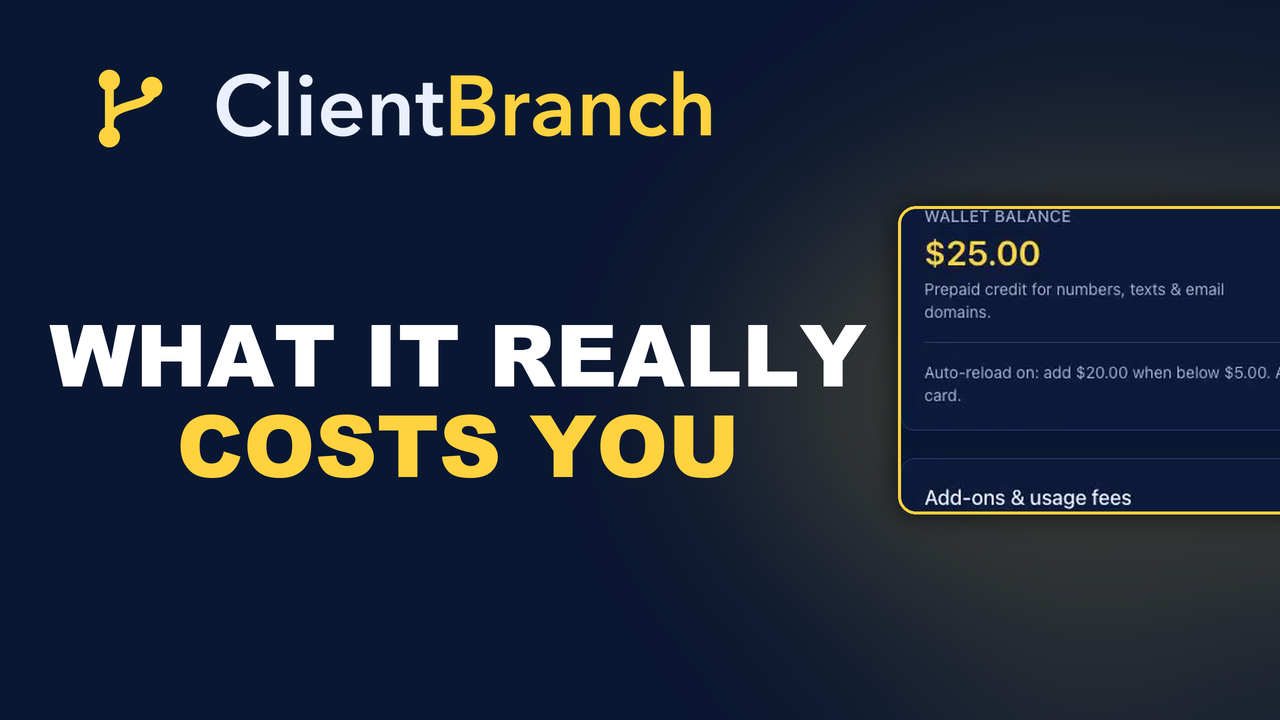
Usage comes out of a prepaid wallet rather than off your card each time. You top it up in chunks, and it can reload itself when it runs low.
That last part matters more than it sounds. A reminder that fails to send because a balance hit zero on a Sunday is the one message you most needed to go out. Auto-reload removes that failure mode entirely.
What the per-use prices are
Texts are two cents a segment. Picture messages are five cents.
Receiving anything costs you nothing. Email is included too: 5,000 emails a month on every plan, then $1 for each extra 1,000, and never a charge per contact. Both are worth saying plainly, because a lot of platforms meter inbound messages and charge per contact for email, and both of those are the sort of cost that grows exactly as your business does.
A word on segments
A text gives you 160 characters per segment, and the segment is the billing unit. A longer message splits into two and costs two.
Add one emoji and the whole message switches to Unicode, which drops you to 70 characters a part. It is the most common way a text budget doubles without anybody noticing. The composer shows you the count before you send, so it is avoidable rather than mysterious.
The recurring add-ons
Two of them exist. A rented phone number is a few dollars a month. Connecting your own sending domain is two.
They are listed on the billing screen with their own price and renewal date, and the total sits at the top of the panel. That is the entire list of recurring extras. There is nothing else to discover.
Every charge is itemised
Underneath the wallet is the activity list: every top-up and every charge, with what it was for.
If the balance ever looks wrong you can see exactly what it went on rather than guessing or opening a support ticket. This is the screen that makes the rest of it trustworthy, because a prepaid balance with no itemised history is just a number you have to take on faith.
Changing plans does not lose anything
Moving up takes effect immediately. Moving down keeps your data.
You lose access to the modules that plan does not include, and nothing is deleted. Come back up later and everything is where you left it. That is deliberate, because the fear of losing work is what keeps people on a plan they have outgrown in the wrong direction.
What we do not do
No per-contact pricing, so growing your list does not quietly raise your bill. No per-ticket fee on events. No per-lead charge on quizzes or forms. No transaction cut on payments beyond what your own payment processor charges you directly.
Those are the four places small business software most often takes a second bite, and none of them apply here.
Trials, and what happens at the end of one
A trial runs the full platform, not a cut-down version, so you are testing the thing you would go on to buy. The billing screen shows which modules are above the plan you would land on, so you find out what is on loan before you pay rather than after.
When it ends, nothing is deleted. You keep the account, and the modules outside your plan stop opening until you move up.
Why a wallet instead of metered billing? Metered billing means an invoice at the end of the month for an amount you did not choose. That is fine for a business with a finance team and unnerving for one without.
A prepaid balance inverts it. You decide the exposure up front, the number only goes down by amounts you can see, and the worst case is that sending pauses rather than that you get a surprise bill.
Read it yourself
All of this is on one screen inside your account under Settings, then Billing. Plan at the top, wallet underneath, add-ons with their renewal dates, itemised activity below that, and the plan comparison at the bottom.
One plan price, a prepaid wallet for texts and rented numbers, and an itemised list of both. Nothing hidden, and nothing charging you for a module you are not using.
Start your free trial and see the numbers for yourself.
Try ClientBranch free for 15 days
Get booked, get paid, and keep clients coming back, all from one place. No card required, cancel anytime.
Start my 15-day free trial